
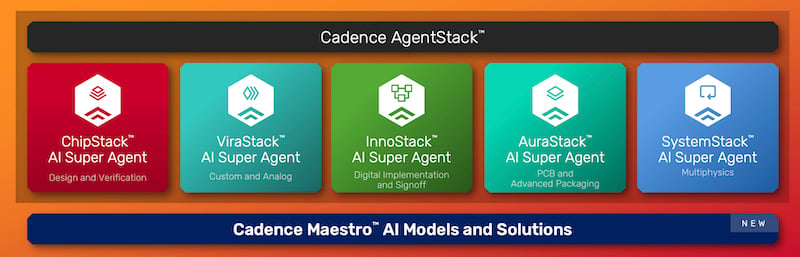
The domain-specialized model portfolio is trained against Cadence’s own EDA tools and reaches early access customers this quarter.
Cadence Design Systems introduced Maestro, a portfolio of domain-specialized AI models built to run its AI Super Agents for chip and system design. The models are post-trained on Cadence’s tools, IP, and engineering knowledge, and the first will reach select early-access customers in the fourth quarter of 2026. Cadence said initial results across design workflows show up to 30% higher-quality results and up to five times greater token efficiency than general-purpose foundation models.
What Is the Maestro AI Model Portfolio?
Maestro isn’t a single model, but a portfolio spanning multiple model sizes and architectures, combining post-trained large language models, trained decision models, and self-improving agent skills.
Cadence’s briefing materials split the offering into three parts. The first is a set of domain-specialized models: leading foundation models post-trained on Cadence tools, IP, and expert knowledge. The second is model routing, which decides whether to send a task to a Maestro model, a frontier model, or a deterministic tool to get the best result at the lowest runtime and token cost. The third is a customer-specialized tier, where Cadence post-trains Maestro models further on a customer’s proprietary designs, data, and workflows.
The Cadence AI stack.
In Cadence’s AgentStack architecture, Maestro sits between the Super Agents and the company’s JedAI Data and AI Platform. JedAI handles security and authentication, the model gateway, embedding services, agent orchestration, telemetry, and cost and licensing controls. The full environment can run on Cadence’s secure cloud, on secure public clouds, or on customer-controlled on-premises hardware.
How Maestro Works With Cadence’s EDA and SDA Tools
Maestro powers four Super Agents that Cadence has introduced over the past year. ChipStack covers front-end design and verification, driving tools such as Xcelium Logic Simulation and Jasper Formal Verification. InnoStack handles digital back-end implementation and sign-off. ViraStack targets analog design and migration, while AuraStack covers PCB and advanced packaging within Allegro AI Studio. Each agent interprets a design objective, breaks it into tasks, orchestrates models and tools, and evaluates the results before deciding its next action.
Cadence pairs the models with reinforcement learning loops wired directly into its electronic design automation and system design and analysis tools, and deterministic solvers and evaluation harnesses score each output against engineering objectives and constraints. Because simulation and sign-off tools return objective verdicts, they provide a verifiable reward for training, while Cadence says that balancing tool calls against LLM invocations also reduces token usage.
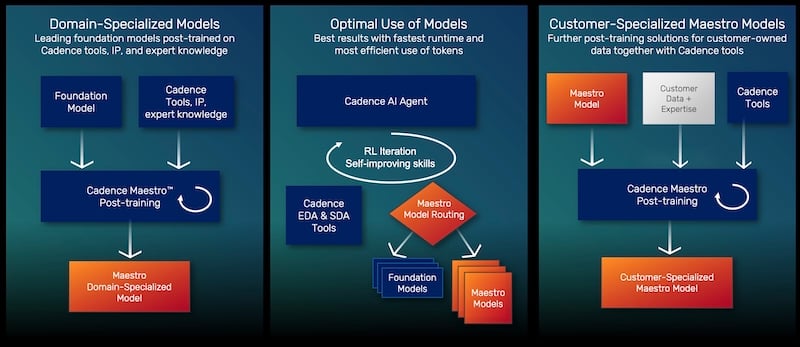
Cadence Maestro’s AI models and solutions.
Cadence’s materials also describe “bespoke lightweight surrogate AI models” embedded inside its tools, which learn dynamically as a project runs, along with fine-grained RL iteration on low-level tool behavior to speed up debug. Maestro models can also be combined with frontier and open-weight models, with the Super Agents routing each task to whichever model or tool suits it best.
Designers Still Needed
Cadence describes Maestro not as a replacement for designers, but as a way to offload execution-heavy work, such as regression debug and timing and power convergence, rather than removing engineers from the loop. In its earlier ChipStack announcements, the company described engineers shifting from executing individual tasks to supervising outcomes, with the ability to inspect and redirect an agent’s work at any point. The customer-specialized tier also depends on design teams supplying their own data and expertise to tune the models.
Socionext, for example, is deploying InnoStack in its production physical design environment and said it expects up to five times overall productivity gains while maintaining design quality, while Silicon Labs said its engineering teams accelerated root-cause analysis and end-to-end debug during pre-silicon low-power verification by using Cadence Verisium Debug within ChipStack. Both companies said they plan to adopt Maestro models as they become available.
All images used courtesy of Cadence