Acorn’s two-person team put a 32-bit RISC processor into a £799 desktop that outran a 16-MHz Compaq 386.
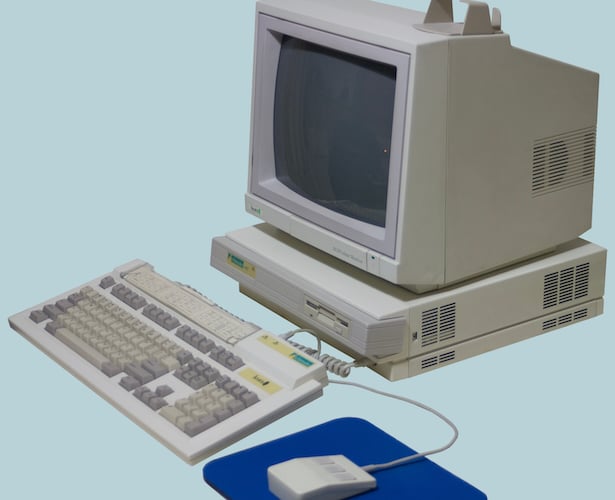
In June 1987, Acorn Computers of Cambridge, England, launched the Archimedes, a desktop built around a 32-bit RISC processor of its own design, with the entry-level A305 at £799. The ARM2 inside ran at 8 MHz, had roughly 30,000 transistors, and delivered 4,901 Dhrystones per second in Byte’s October 1987 preview—31% ahead of a 16-MHz Compaq Deskpro 386.
Acorn’s Archimedes. Image used courtesy of PaulVernon1974 via Wikimedia Commons (CC0)
Sophie Wilson and Steve Furber had designed it as a replacement for the 6502 in Acorn’s BBC Micro, after the company tried and rejected the leading 16-bit CPUs; neither had built a microprocessor before. Acorn co-founder Hermann Hauser joked that the project’s two advantages over its bigger rivals were that it had “no people” and “no money.”
Two Papers and a Trip to Phoenix
Acorn had sold over 1.5 million BBC Micros against an initial forecast of 12,000, and needed something faster than a 2-MHz 6502 to hold off the IBM PC compatibles. It evaluated the Motorola 68000 and built second-processor boards around the National Semiconductor 32016 and Intel 80286. Furber told the Computer History Museum in 2012 that the 16-bit chips couldn’t service interrupts as fast as the 6502 and could not keep pace with cheap DRAM. He singled out the 32016’s memory-to-memory divide, a single instruction that ran for 360 clock cycles with no way to interrupt it.
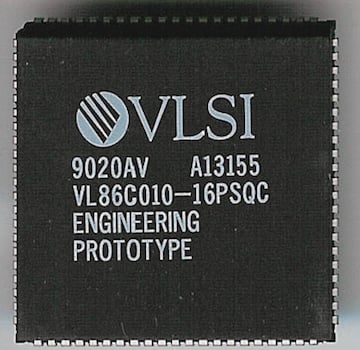
The ARM2 CPU. Image used courtesy of CPU Shack
In October 1983, Wilson and Furber visited the Western Design Center in Phoenix, Arizona, where Bill Mensch’s small team was laying out 6502 successors on drawing boards with Rubylith tape. Furber recalled leaving with the thought, “If they can design the microprocessor, then maybe we can too.” By Furber’s account, Hauser had handed the pair the Berkeley RISC and Stanford MIPS papers earlier that year. Wilson wrote the instruction set and Furber the three-stage microarchitecture, and the whole reference model and development environment ran in about 850 lines of BBC BASIC on a BBC Micro. Wilson’s slogan for the project was “MIPS for the masses.”
VLSI Technology fabricated the first ARM1 on a 3-µm process, and the chips arrived on April 26, 1985. By that afternoon they were running BBC BASIC on a second-processor board; Wilson typed PRINT PI, got the right answer, and the team popped open the champagne. ARM1 held about 25,000 transistors; Intel’s 80386, launched the same year, had 275,000.
What the ARM2 Added
The ARM2 came in late 1986 as VLSI part VL86C010, on a 2-µm, double-metal CMOS process in an 84-pin plastic package. Over ARM1, it added multiply and multiply-accumulate instructions, a Booth multiplier that finished a 32 x 32 multiply in 16 clocks worst case, a coprocessor interface, and two more registers, for 27 with 16 visible at a time. The rest was the original design, which VLSI’s data book describes as a system “centered around the memory.”
The processor ran at 8 MHz (125 ns), while ordinary 120-ns, page-mode DRAMs were slower; most of the instruction set exists to keep that bus busy. A single load or store took two clocks. Block load and store instructions, there “to exploit sequential memory access modes” in the data book’s words, took two clocks for the first register and one for each after it, so a 16-register save ran near the DRAM’s page-mode rate. The ARM2 flagged every access as sequential or not on a dedicated pin, and the MEMC memory controller used that flag to decide whether to stay in the open DRAM page. MEMC, the VIDC video controller, and the IOC I/O controller completed Acorn’s four-chip set, all fabricated by VLSI.
Furber’s other complaint about interrupt latency on the 16-bit chips got the same treatment. Subroutine calls saved the return address in a register rather than on a stack, so a call or a return cost one clock. The fast-interrupt mode had its own banked registers, and every instruction carried a condition code, so, instead of a pipeline flush, a short forward branch ran as a few skipped instructions. The ARM2 had no cache, but the ARM3 added one in 1989; Furber said it ran five times faster in real Archimedes systems on a clock only 2.5 times higher.
Furber said the tools of the day couldn’t predict power well, so they worked to “Victorian engineering margins” and came in under a tenth of a watt. VLSI’s data book gives 20 mA typical at 10 MHz, about 0.1 W. Wilson said that “making it power efficient was an accident.” Byte’s Dick Pountain, benchmarking the A310 in October 1987, called it “probably the world’s fastest personal computer” and “the first RISC machine inexpensive enough for home use.”
350 Billion Chips
After 1988, Acorn sold little that wasn’t ARM-powered. When Apple went looking for a processor for its Newton handheld, Acorn, Apple, and VLSI Technology spun the design out into a separate company. Advanced RISC Machines Ltd. was founded in November 1990 with 12 Acorn engineers in a converted barn outside Cambridge.
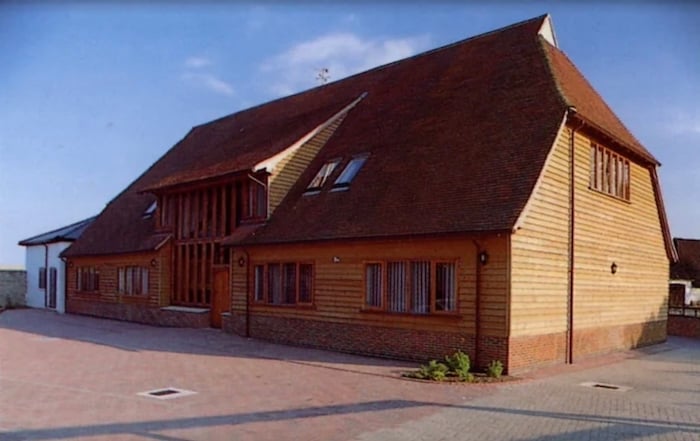
Arm was founded in 1990, with its first headquarters in an outfitted barn in Cambridge. Image used courtesy of Arm
Arm said in May 2026 that more than 350 billion Arm-based chips had shipped, and Wilson and Furber shared the 2022 Draper Prize with John Hennessy and David Patterson, whose Stanford and Berkeley papers had reached Acorn in 1983.
Did you own an Archimedes, or write assembly for the ARM2? Tell us about it in the comments below.