The company’s new FemtoClock 4 and VersaClock 8 product families are aimed at surging AI data center bandwidth demands following its strategic acquisition of Renesas timing business.
SiTime has announced the the launch of its FemtoClock 4 and VersaClock 8 product families, targeting the surging demand for high-bandwidth clocking solutions in artificial intelligence (AI) and data center networks.
The launch follows SiTime’s strategic acquisition of Renesas’s timing business, positioning the company to address a serviceable addressable market (SAM) estimated at $2 billion. These new clock generators and jitter attenuators are designed to meet the rigorous demands of next-generation networking equipment, including 224G SerDes and PCIe Gen7 architectures. To learn more about the news, we spoke with Piyush Sevalia, Executive Vice President, Chief Business Officer at SiTime.
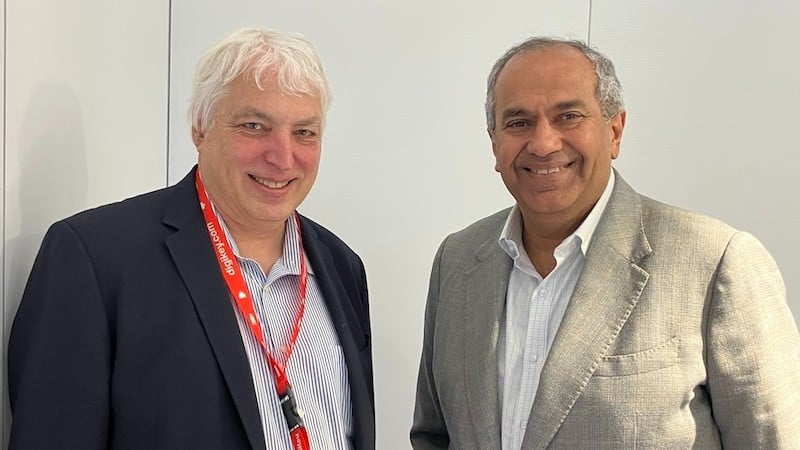
Jeff Child, All About Circuits’s Editor-in-Chief and Piyush Sevalia, Executive Vice President, Chief Business Officer at SiTime at Electronica 2026.
The Bandwidth Challenge in AI Data Centers
The explosive growth of AI workloads is driving an insatiable need for bandwidth within data centers. As GPUs become increasingly powerful and expensive, minimizing their idle time is critical for economic efficiency.
“You’ve got to keep the GPUs busy because they are so expensive,” said Sevalia. “And so there is a major upgrade happening in networking both on the Ethernet side as well as on the interconnect side.”
This constant pressure for faster data movement is forcing a doubling of bandwidth every two years. Current top-of-rack switches and smart NICs are transitioning to 224G SerDes per lane for Ethernet connectivity, while server motherboards and accelerator interconnects are moving to PCIe Gen7, which doubles the bandwidth of Gen6 to 128 GT/s.
These high-speed standards demand extremely low-jitter clocking sources to ensure signal integrity, prevent bit-error rates from climbing, and avoid costly retransmits that degrade system performance.
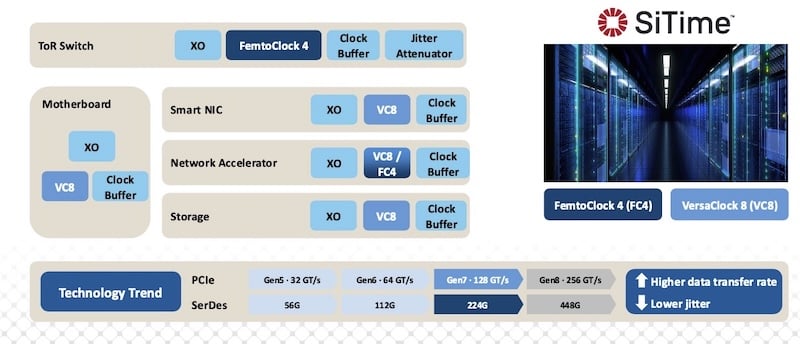
Where the FemtoClock 4 and VersaClock 8 (VC9) clock devices fit in in AI data center designs.
FemtoClock 4: Targeting 224G SerDes Top-of-Rack Switches
The FemtoClock 4 family (which includes the RC38616, RC38412, RC32418, and RC32412 variants) is aimed squarely at the demanding top-of-rack and spine switch market. According to SiTime, a modern Ethernet switch ASIC can require more than 40 clocks, a number that is only expected to grow.
To address this density, the FemtoClock 4 architecture is highly integrated. The flagship RC38616 model, packaged in a compact 10 mm x 10 mm 144-BGA, features:
- Up to six independent frequency domains: This allows a single device to synchronize multiple distinct domains within a complex system.
- 18 differential output pairs: These outputs can be configured for various signaling standards (CML, LVDS, HCSL, or LVCMOS).
- Ultra-low phase jitter: The device delivers an impressive 19 fs RMS phase jitter at 312.5 MHz (measured from 12 kHz to 20 MHz with a 4 MHz high-pass filter) in clock generator mode.
The challenge of packing this much functionality into a single die is managing internal crosstalk. “When you have so many different PLLs, there’s a lot of noise in the system. You’ve got to make sure that the noise is isolated,” said Sevalia. “Otherwise, it’s going to creep into the outputs as jitter. And when you’re trying to meet the jitter spec sub 50cond jitter spec for 224G that’s not easy.”
The FemtoClock 4 leverages four generations of architectural refinement to isolate internal noise, ensuring solid performance even under noisy power supply conditions typical of dense server environments.
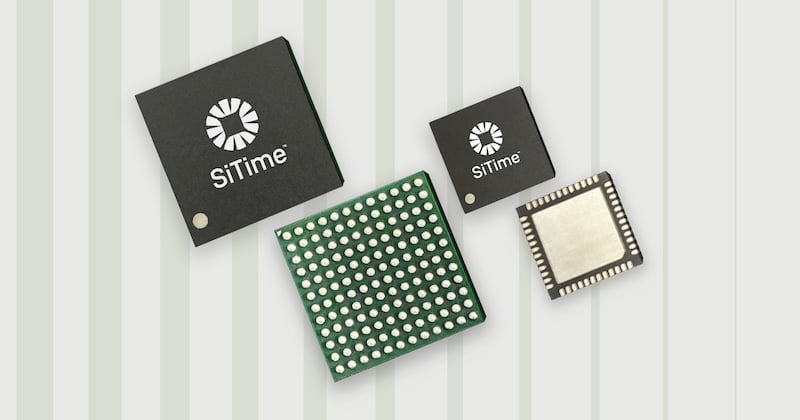
FemtoClock 4 (left), VersaClock 8 (right)
VersaClock 8: PCIe Gen7 Clocking for Computing and Interconnects
Complementing the FemtoClock 4 is the VersaClock 8 family (including the RC31312A, RC31309A, and RC31305A), which is designed for motherboard interconnects, smart NICs, network accelerators, and storage applications relying on PCIe.
VersaClock 8 devices are highly flexible, programmable clock generators that offer:
- PCIe Gen7 Compliance: They deliver an outstanding 10 fs reference clock jitter, well below the requirements for PCIe Gen7, providing significant timing margin for designers.
- Low Phase Jitter: The devices achieve 30 fs RMS phase jitter at 312.5 MHz (12 kHz to 20 MHz, 4 MHz high-pass filter).
- Compact Footprint: Available in 5-, 9-, and 12-output variants in QFN packages as small as 4×4 mm. SiTime claims the 12-output variant is roughly 40% smaller than comparable solutions.
- High-Temperature Operation: The low-power architecture reduces self-heating, allowing operation up to 105°C board temperature, a crucial feature for densely packed computing boards.
The architecture includes a single PLL and fractional output dividers, allowing the generation of up to three distinct frequency domains from a single chip. It supports both Common Clock (CC) and Independent Reference (IR) PCIe clock architectures and can store up to 18 configurations in its internal One-Time Programmable (OTP) memory.
A Unified Timing Portfolio
With the integration of the Renesas timing business, SiTime is pitching itself as a comprehensive “one-stop-shop” for data center timing. While the FemtoClock 4 and VersaClock 8 handle the complex clock generation and distribution, SiTime’s core MEMS oscillators (such as its TCXOs) provide the fundamental, ultra-stable synchronization pulses required across the network.
“Nobody else has that kind of diversity of portfolio,” said Sevalia. “And so it simplifies the customer’s job to just buy from us and get everything in place and then move on to the next big problem they have to solve.”
Looking ahead, SiTime plans to further integrate these technologies. Future roadmaps indicate the development of devices that combine the complex clocking architectures of the newly acquired families with the ruggedness and stability of SiTime’s MEMS resonators, potentially offering built-in shock and vibration resilience in highly integrated packages.
The FemtoClock 4 and VersaClock 8 families are currently in production and available. Datasheets, design files, and evaluation kits (such as the RC31309-EVB and RC31312-EVB) are available to support design-in efforts.
All images used courtesy of SiTime.