Humanoids are entering pilots before their safety standards are finalized. In this interview, Renesas’ Brad Rex explains that functional safety must encompass layers: joints, AI behavior, and the safe state.
Humanoid robots are moving into factory and warehouse pilots while the standards that govern them are still in development. Established functional safety standards such as ISO 26262 and IEC 61508 focus on keeping electronics working correctly during faults. They were not written for machines that walk, make decisions with AI models, and work within arm’s reach of people.
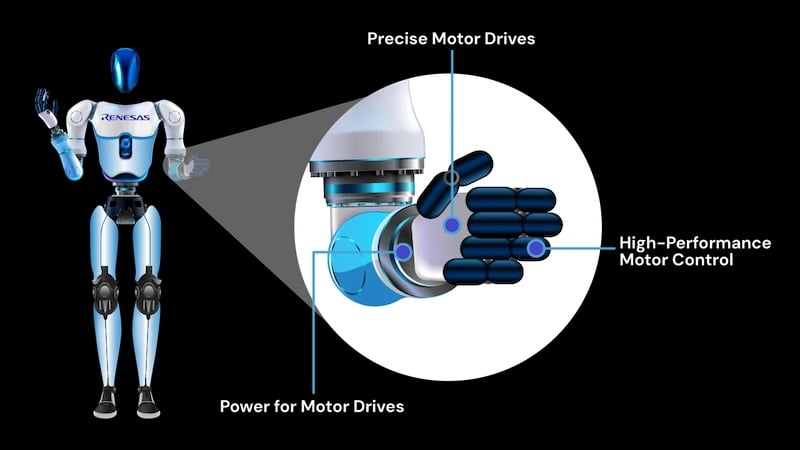
Renesas is expanding its product portfolio to support new humanoid robotic applications. Image used courtesy of Renesas.
The draft ISO 25785-1 targets this gap for industrial mobile robots whose stability depends on continuous power and control, including humanoids. It is still a draft, so design teams are making architecture choices now without a finished rulebook.
Brad Rex leads Physical AI and Humanoid Robotics at Renesas Electronics, with more than 25 years in embedded systems across Renesas, NXP, Qualcomm, and Texas Instruments. Ahead of his upcoming All About Circuits webinar, “Physically Safe: Extending Functional Safety for Humanoids and Physical AI,” on Nov. 18 at 11 a.m. EST (8 a.m. PST / 5 p.m. CET), we spoke with him about where safety engineering for humanoids has to change.
Four Areas of Humanoid Safety
The webinar argues that functional safety for humanoids must expand to cover four areas: device integrity, operational safety, AI behavior, and human interaction. Of the four, Rex says, the device layer is the part the industry already knows how to solve. Traditional device-level safety is mature, he says: “This is very well understood.” The least-understood area is AI behavior. “AI can kind of do many things, and you don’t know exactly what it’s gonna do at any given time,” he explains.
That unpredictability is what makes standards so hard to write. “How do you take something that’s very nebulous and relate that back to making a safety standard for it?” Rex asks. Standards bodies, including the IEC, are working on it, with humanoid certifications expected around 2028. Rex calls it “the key thing that needs to be solved over the next few years and the next decade.”
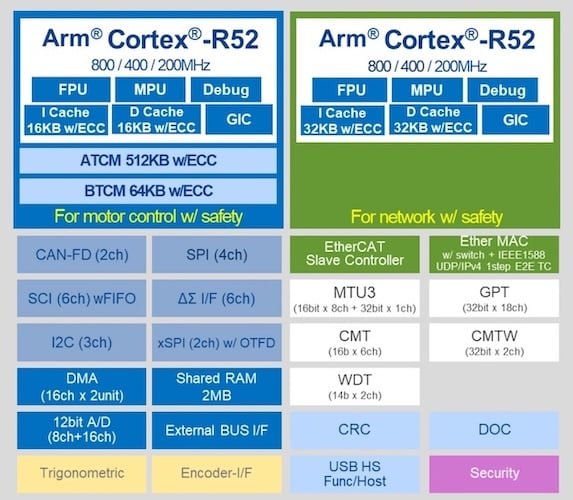
The RZ/T2ME MPU is an example of a Renesas product that includes built-in security functions. Image used courtesy of Renesas.
Safety of the Robot and Safety of the Task
Device-level functional safety is familiar territory. The usual response to a fault is to come to a safe stopped position. In industrial robotics, Rex notes, “safe” has traditionally meant stopped, with the machine staying put until an operator arrives.
That does not work for a humanoid. “With a humanoid, there is no real stop button,” he says. Cutting power leaves a legged robot unsupported, and “when a robot fails, it fails in a very spectacular fashion… it usually falls on the floor.” Near people, that fall is a hazard in itself. In Rex’s words, “safe is not always stop.”
New safe states are needed instead. A humanoid might keep “enough power to stay still” for a period of time, or “go into a crouch position.” These behaviors could live in the central brain, the limbs, or both. They also raise a design question: does the robot need an extra, reserved power budget?
Safety also has to be considered at the task level. Picture a humanoid helping an elderly person up off the floor after a fall: safety in the middle of that task looks different from safety before or after it. Rex agrees that robot safety and task safety are separate layers. He expects layered security or functional safety levels, with low-level device safety at the base and higher-level controls for a particular task above it. Safety features already built into Renesas MCUs support the lower layers.
For situations like that, “a lot of this will have to be defined for each use case.” That is one reason Rex does not expect a fully general-purpose humanoid soon. “We’re not there yet,” he says, and “the first iterations of robots are going to do a smaller set of tasks.”
Partitioning Safety From the Brain to the Joints
For partitioning, Rex offers a simple picture: “You have to look at safety as a layered onion.” The base layer is device-level functional safety, with certified components. Above it come the task level and the AI level, with safeguards between the layers.
Silicon already supports this separation. Renesas RZ microprocessors and R-Car SoCs offer multi-core partitioning. The AI workload, real-time motor control, and general-purpose processing can run on separate cores. Safety islands from automotive silicon carry over well.
Because software will keep changing, Rex says the hardware decisions are the urgent ones: “we need to lock the hardware now,” with enough redundancy and forethought for safety. He also warns against expecting a single answer for AI safety. “You’re never going to get a one-size-fits-all.”
Some safety functions belong at the joints and limbs rather than in the central brain. Rex points to functions that can run “more toward the edge of the humanoid,” in some cases continuing to operate even if the central brain has a problem. His examples include “torque and force sensing,” “impedance control and sensing,” touch detection with “e-skin,” “inertial motion,” and “gait control.”
Inertial motion and gait control can run as a motion-control subsystem, similar to a cerebellum, without involving the central brain. Similarly, an intelligent dexterous hand can react if its grip force climbs too high; the hand can release or stop.
Keeping Adaptive AI Inside the Lines
Adaptive AI needs guardrails, and Rex’s answer is to put truly deterministic systems at the end of the line. “AI can think about what needs to be done, but ultimately that has to be then translated down to something at a more deterministic level,” he says.
He describes the better designs as a push-pull between the two, with restrictions and feedback applied to the AI’s decisions. In his example, the AI might direct the robot to walk 15 steps. “AI wants me to walk, you know, 15 steps,” Rex says, but if a limb detects a wall, “I have to stop… and then basically alert back up.”
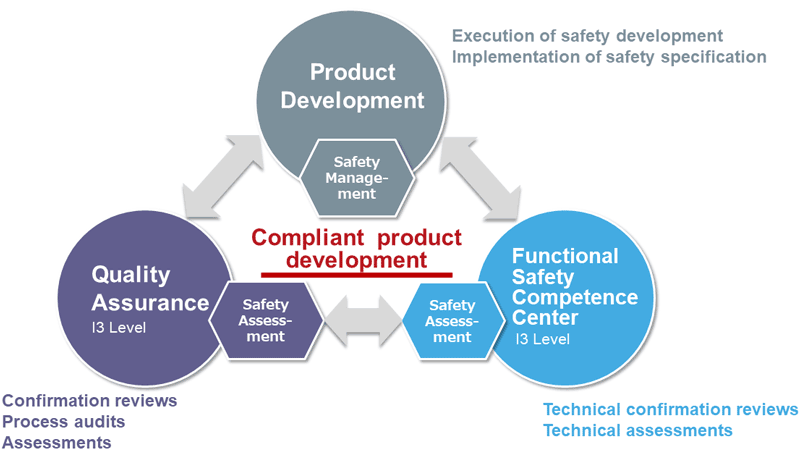
An example framework of an integrated development process for designing, testing, and maintaining safe systems. Image used courtesy of Renesas.
Borrowing From Automotive
Much of the automotive safety work behind R-Car SoCs, which the webinar covers for humanoid applications, carries over. “A lot of what we do in automotive actually maps very closely into robotics,” Rex says. He cites perception, motor control, redundancy, and real-time separation as areas where automotive designs carry over, along with the ASIL-based certification approach.
What is new sits above that foundation: the task-level and AI-level layers, and the safeguards between them, which are still being defined.
Over-the-Air Updates and Safety Certification
Over-the-air updates bring their own safety questions. Rex says software provenance is now part of safety. An unauthorized or corrupted firmware update invalidates the system’s functional safety certification.
Trusting where an update comes from, and reflashing reliably, are essential to avoiding rogue updates. “The lineage of where that software came from and how you track it actually will become very important,” he says. Features like cryptographic signing, a hardware root of trust, and secure boot will support this.
Looking Ahead: What is Safe?
Rex hopes the webinar will make people think hard about what is safe for a humanoid robot, and he expects safety to be critical for any humanoid to reach mass production. To hear more from Brad on the application of functional safety for humanoid robotics, register for the webinar “Physically Safe: Extending Functional Safety for Humanoids and Physical AI” on All About Circuits. It will be held Nov. 18 at 11 a.m. EST (8 a.m. PST / 5 p.m. CET). If you can’t make it for the live webinar, it will also be available on demand.