
Weebit Nano’s research kits give researchers ReRAM crossbar chips, boards, and sample code to prototype in-memory compute on silicon.
Moving data between memory and processors consumes much of the power used in AI inference, according to Eran Briman, Weebit Nano’s vice president of marketing and business development. Speaking with All About Circuits at electronica 2026, Briman described how in-memory computing (IMC) could reduce that burden. Weebit’s new Matrix IMC Research Program gives researchers resistive RAM (ReRAM) hardware to explore the approach on silicon, with an eye toward lower-power edge AI.
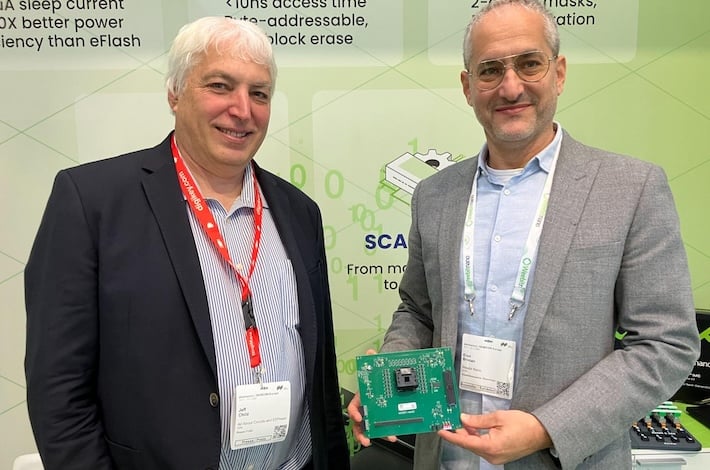
Jeff Child of All About Circuits and Weebit Nano’s Eran Briman with the Weebit Matrix IMC board at Electronica 2026.
The Weebit Matrix IMC Research Program
Systems running AI inference must repeatedly move weights and data between memory and processors, consuming both power and time.
“60 to 80% of [the] power consumption is actually consumed just by these data movements,” says Briman.
Designers pay in time as well, he adds, because a GPU can sit idle half the time while it waits for data. With IMC, teams cut both costs by leaving the data where it is and computing inside the memory array.
To let researchers try that approach on real chips, Weebit offers two kits. “The purpose here is to allow these researchers to do their own developments based on real hardware, not just simulation,” Briman says. Device researchers can choose the Evaluation package for direct analog access to the chip. System-level teams can pick the Quick-Start package, which adds an FPGA subsystem and sample code. Briman says each kit also includes 10 packaged chips, a socketed IMC board, and documentation.
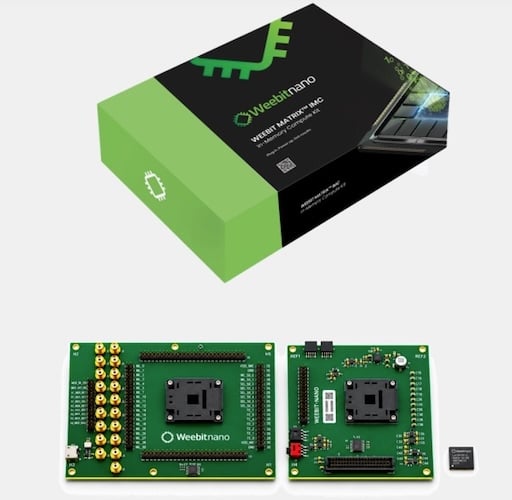
The Weebit Matrix in-memory compute development platforms. Image used courtesy of WeeBit Nano.
Each chip contains a 32 × 32 crossbar array of one-transistor, one-resistor (1T1R) ReRAM cells. Researchers can program individual cells to different resistance levels, representing analog weights. The array then performs multiply-accumulate (MAC) operations that researchers can use to implement computations such as convolution.
For now, Weebit limits the kits to research and prototyping, not commercial products. Researchers from industry or academia apply by submitting a project, which Weebit reviews against the program’s research focus. Accepted teams buy the kit and agree to share what they learn about the ReRAM. “They have to give us their feedback. And that’s very important,” Briman tells us.
The program builds on the ReRAM technology Weebit already develops as an embedded flash replacement. Briman says that reuse makes IMC research a relatively small additional effort for the company. ReRAM is also non-volatile, allowing researchers to retain stored weights when power is removed. As Briman puts it, “Program it once. It stays there.”
Researchers have already estimated the potential savings. In a Weebit case study, a U.S. hardware developer projected about 80 times lower power than a desktop GPU on the same image classification task. Its engineers modeled that figure from measured ReRAM arrays, not from a complete accelerator.
How Resistive Crossbars Compute in Memory
To perform arithmetic inside memory, engineers arrange resistive elements in a crossbar of intersecting rows and columns. Each element’s conductance represents a matrix entry, such as a neural network weight, as Daniele Ielmini and H.-S. Philip Wong explain in Nature Electronics.
When designers apply input voltages across the array, each element passes a current equal to its conductance times the voltage. Those currents add along the output lines under Kirchhoff’s current law, so users read a weighted sum in one step. That weighted sum is the MAC operation at the core of neural network inference.
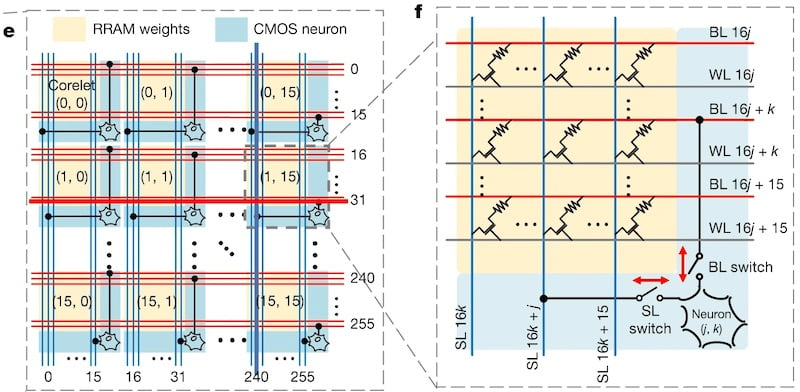
A resistive RAM compute-in-memory array with 1T1R cells at the intersections of bit, word, and source lines. The diagram does not show the Weebit Matrix IMC chip. Image used courtesy of Wan and co-authors. (CC BY 4.0, cropped).
However, designers pay for that speed in accuracy. Resistive devices vary from cell to cell and from cycle to cycle, so identical inputs can return different sums. As a multi-university team reported in Nature, simulations that leave out such hardware effects predict better accuracy than chips deliver.
A First Step Toward Commercial IMC
Researchers interested in reducing AI’s data-movement costs can now apply to Weebit’s Matrix IMC Research Program. The company has not publicly disclosed kit pricing.
Designers who want IMC in production chips face a longer wait. In the announcement, Weebit CEO Coby Hanoch acknowledged that the company faces technical challenges before it can commercialize IMC. Briman calls the kits “just our first step” and says Weebit aims to offer commercial IMC IP in two to three years. He adds that microcontroller vendors at electronica want that IP next to their cores to run AI functions. Designers who place it there, Briman tells us, “don’t need to stream the weights in and out all the time.”