The two-wire Hall-effect switches report magnetic state and internal faults.
Melexis has introduced the MLX92342, a programmable two-wire Hall-effect switch that designers can mount without a local PCB. With automakers moving to zonal architectures, designers are placing more sensing at remote endpoints and consolidating processing in zonal electronic control units (ECUs). In turn, they need endpoint sensors that sit close to the mechanism, work without a circuit board, and still report their own faults.
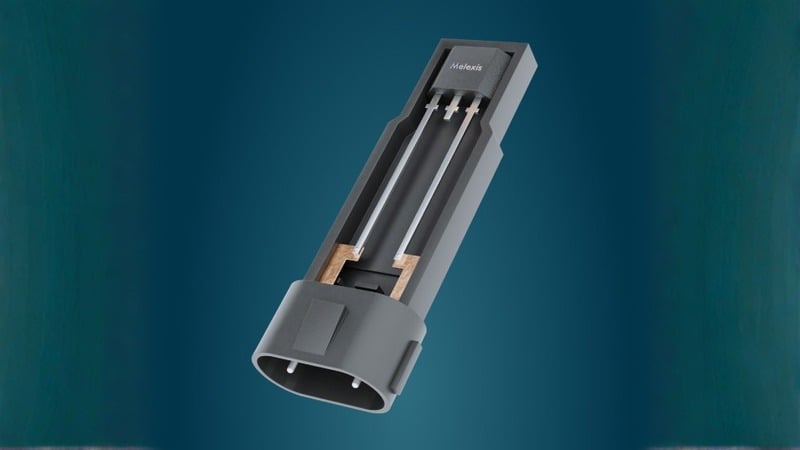
A PCB-less MLX92342 installation, with no circuit board between the sensor and the connector. Image used courtesy of Melexis
Understanding these challenges, Melexis hopes the MLX9234 will help designers bring functional safety to the farthest edges of the vehicle.
The MLX92342 and MLX92341
Seatbelt buckles show how something as innocuous as a simple position switch can become a safety component. When restraint-system logic reads the buckle signal, the ECU needs to know whether the belt is fastened and whether that reading is trustworthy.
To meet that need, Melexis developed the MLX92342 according to ISO 26262 and classifies it as ASIL B SEooC. Functionally, the switch reports its magnetic state by changing its current draw. For buckles, Melexis cites typical programmable levels of 2 mA to 5 mA or 5 mA to 6.9 mA unbuckled and 12 mA to 15 mA buckled. Melexis also routes every on-chip diagnostic to a single safe state, which the device reports as a current below 1 mA. With that separation, ECU designers can distinguish a sensor or wiring fault from a fastened or unfastened belt.
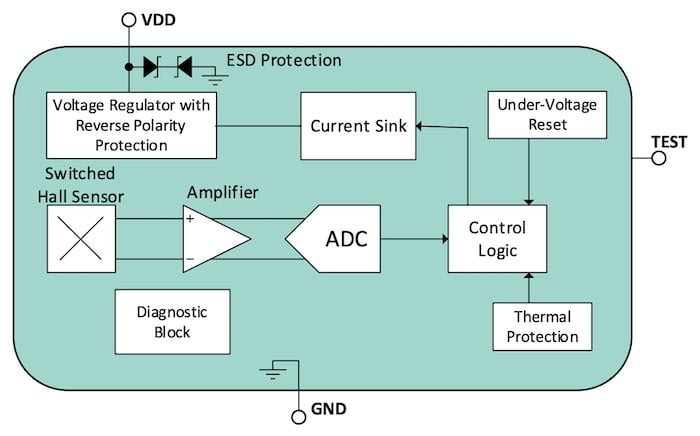
MLX92342/1 functional diagram. Image used courtesy of Melexis
Beyond fault coverage, buckle detection also places demands on timing. According to Melexis, the MLX92342 delivers a valid output plus safety signal in under 100 µs. The company says that speed helps because ECUs may read buckle status within very short test windows. Designers can also choose a sequential diagnostic mode for faster fault reporting or a parallel mode for faster magnetic updates.
To fit different mechanisms, designers can program the MLX92342 as a magnetic latch, unipolar switch, or omnipolar switch. Melexis lists a 0.5 mT to 200 mT range, or up to 40 mT for variants with an integrated magnetic concentrator (IMC) for lateral sensing. Manufacturers can also program switching thresholds after assembly, which Melexis says lets them calibrate out each buckle’s mechanical tolerances.
Diagnosing Faults Over Two Wires
One long-standing challenge in automotive position sensing is reporting faults over the same two wires that carry power and signal. In a conventional three-wire Hall switch, designers run separate supply, ground, and output lines to each sensor. With two-wire designs, engineers drop the output line and read the switch state from the current each sensor draws.
For example, Analog Devices notes that typical two-wire sensors draw roughly 5 mA to 8 mA when off and 11 mA to 14 mA when on. Because a working sensor always draws some current, engineers can also detect open circuits and shorts from the line current.
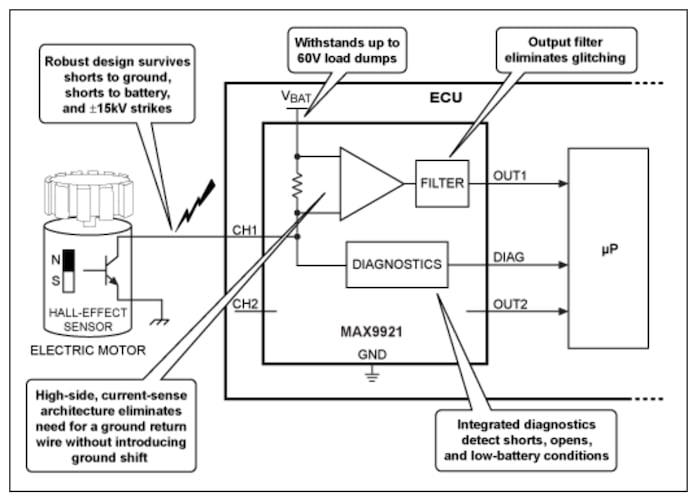
A typical two-wire Hall-effect sensor interface using the Analog Devices MAX9921, which monitors sensor current and flags shorts and open circuits. Image used courtesy of Analog Devices
However, engineers cannot see a failure inside the sensor, such as an element stuck in one state, from two current levels alone. For that reason, sensor makers developing for functional safety can reserve a third current level to flag internal faults.
But it’s not enough for a system to catch faults; it also needs to catch them quickly. ISO 26262 defines the fault-tolerant time interval (FTTI) as the shortest time from a fault to a possible hazardous event without safety intervention. To comply with safety standards, engineers need their systems to detect faults and reach a safe state within that interval. Any time spent waiting for a sensor’s diagnosed output reduces the ECU’s reaction time.
Safety-Ready Sensing for Zonal Endpoints
According to Melexis, the MLX92342 and the pre-programmed MLX92341 are both available now and come in TSOT23-3L surface-mount, TO92-3L through-hole, and PCB-less TO92-3L packages.