
The four new automotive MEMS combination sensors integrate accelerometers, gyroscopes, SafeSPI communication, and diagnostics for vehicle safety.
STMicroelectronics has introduced four automotive safety sensors that combine angular rate and acceleration measurements in a single package. ST designed the new NCS1012BAEP, NCS1012CAEP, NCS1012EAEP, and NCS10135AEP for applications ranging from electronic stability control and rollover detection to crash protection and airbag deployment.
STMicroelectronics’ new automotive combination sensors support active and passive vehicle safety applications. Image (modified) used courtesy of STMicroelectronics
The devices are ST’s first mass-market automotive safety combination sensors following its acquisition of NXP’s automotive and industrial MEMS sensor business earlier this year. All four share a common architecture, including SafeSPI communication, internal diagnostics, and ISO 26262 compliance. The main differences come down to which axes they measure and the acceleration ranges they support.
Four Sensors, Different Measurement Requirements
The NCS1012BAEP combines a Z-axis gyroscope for measuring yaw with a two-axis accelerometer measuring acceleration along the X and Y axes. It supports a nominal acceleration range of ±1.5 g to ±34 g.
The NCS1012CAEP uses an X-axis gyroscope to measure roll, along with a Y/Z-axis accelerometer. It shares the same ±1.5 g to ±34 g acceleration range as the BAEP, but measures acceleration along different axes, including vertical movement.
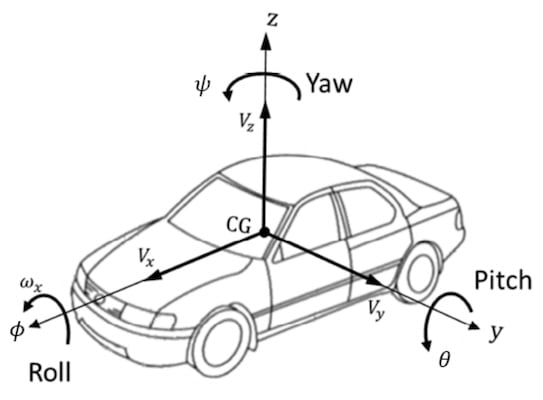
Vehicle motion diagram illustrating the yaw, roll, and pitch axes used to describe automotive sensor measurements. Image used courtesy of Researchgate
The NCS1012EAEP also measures roll along the X-axis, but pairs it with an X/Y-axis medium-g accelerometer. The NCS1012EAEAP has an acceleration range from approximately ±15 g to ±150 g, making it better suited for detecting higher-acceleration events, including those associated with vehicle impacts.
The NCS10135AEP combines a Z-axis gyroscope for yaw measurement with a three-axis accelerometer covering X, Y, and Z. It supports the same ±1.5 g to ±34 g low-g range as the BAEP and CAEP, but measures acceleration across all three axes instead of two.
Integrated Features for Automotive Safety
All four sensors offer selectable angular rate ranges of ±125, ±250, or ±350 degrees per second and operate from -40°C to +105°C. They include built-in low-pass and optional high-pass filters to reduce unwanted noise, along with independent acceleration signal chains. These safety combination sensors also support self-tests, signal-clipping detection, internal voltage monitoring, and memory protection. SafeSPI communication provides status information and CRC error checking to help the vehicle’s controller identify communication errors.
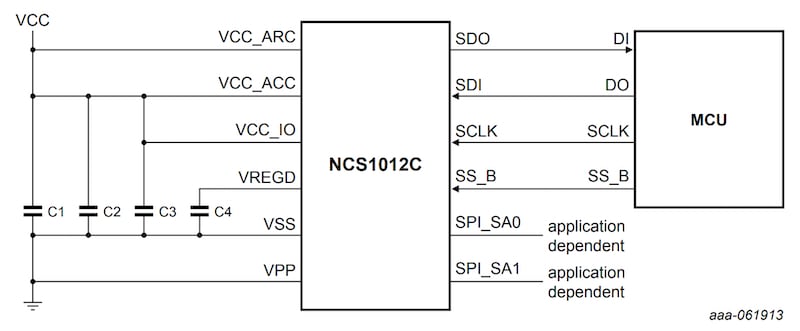
STMicroelectronics’ NCS1012CAEP application circuit showing its power and SPI connections to a microcontroller. Image used courtesy of STMicroelectronics
These diagnostics allow the sensors to detect certain internal faults without relying entirely on external monitoring. The complete automotive safety system still requires its own validation. All four devices operate from a single 3.3-V supply and come in a 24-pin QFN package measuring 6 mm × 6 mm × 1.9 mm.
Building on NXP’s MEMS Technology
ST acquired NXP’s automotive and industrial MEMS sensor business earlier in 2026, and these are the first mass-market combination sensors released since the acquisition. All four use the same basic architecture, safety diagnostics, and communication interface, with different sensing configurations for different applications. ST hasn’t specified which technologies came directly from NXP, so the acquired technology’s exact contribution isn’t clear.
ST is also committing to at least 15 years of product availability. That’s an important consideration for automotive manufacturers, where vehicle programs can remain in production for years and replacing a discontinued component can require additional design and qualification work.
Choosing the Options That Fit
When looking at this lineup of sensors, the main draw is the available suspension options rather than trying to create a one-size-fits-all solution. Engineers can choose between yaw and roll measurements, two- or three-axis acceleration, and low- or medium-g ranges depending on the application. The built-in diagnostics and SafeSPI interface are also worth mentioning, particularly for safety-related systems where detecting sensor faults is just as important as collecting accurate data.