U-blox’s new wireless modules combine low-power Wi-Fi 6/6E, Bluetooth LE, and optional edge AI processing for battery-powered IoT devices.
U-blox recently introduced its new ALMA-W1 series, a family of compact wireless modules built around Nordic Semiconductor’s nRF7120 and nRF7120E chips. Select versions of the modules support Wi-Fi 6/6E, Bluetooth Low Energy, Thread, and Zigbee. U-blox designed the ALMA-W1 series for battery-powered IoT devices; the series also includes multiple memory and antenna configurations, along with optional hardware acceleration for edge AI.
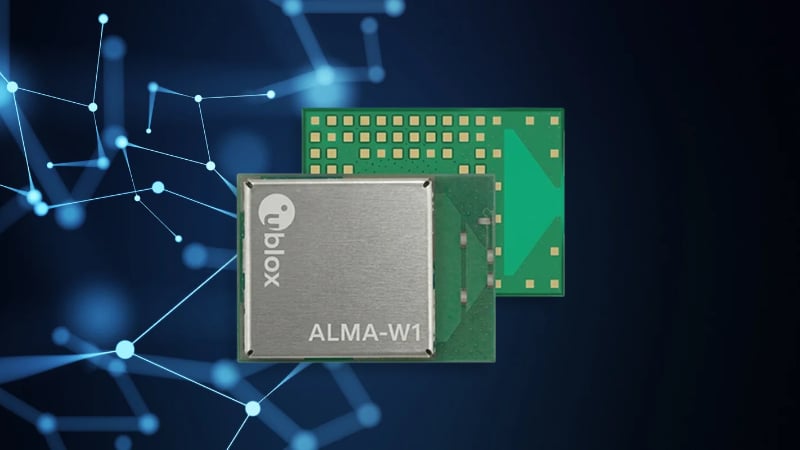
The U-blox ALMA-W1 series combines Wi-Fi 6/6E connectivity, Bluetooth LE, and optional edge AI processing in a compact wireless module. Image used courtesy of U-blox
Wi-Fi isn’t always the first choice for battery-powered devices, mainly because keeping a wireless connection active can consume considerable power. The ALMA-W1 aims to address that problem while giving developers enough processing power to run applications directly on the module. The family includes both programmable wireless MCU versions and network processor configurations for designs that already have a main controller.
Low-Power Wi-Fi 6E Connectivity
The ALMA-W1 supports Wi-Fi 6 at 2.4 GHz and 5 GHz, with Wi-Fi 6E models adding the 6-GHz band. The series includes Bluetooth LE support, while the wireless MCU versions also support Thread and Zigbee. According to U-blox, the modules draw just 8 µA in Wi-Fi connected standby at 5 GHz using DTIM10. Nordic Semiconductor claims that’s part of a more than 20-fold reduction in connected standby current compared with its previous generation. Of course, power consumption increases during operation, with receive current between 10.3 mA and 11.7 mA and transmit current reaching 241 mA at maximum output.
That lower standby draw could make a noticeable difference in devices that spend most of their time waiting to transmit data. However, battery life still depends on how often the module transmits and how long it stays active. Wi-Fi 6 Target Wake Time support provides another way to manage those power demands.
Processing and Edge AI
The wireless MCU versions include a 256-MHz Arm Cortex-M33 processor, a separate 256-MHz RISC-V coprocessor, and 1 MB of RAM. They also provide 63 GPIOs and interfaces including USB, SPI, UART, and I2C. Nonvolatile memory options range from 4 MB to 20 MB.
The tri-band ALMA-W111 and ALMA-W116 models add Nordic’s Axon Neural Processing Unit, allowing supported AI models to run directly on the module rather than relying on cloud processing. This could help analyze sensor readings or identify unusual operating conditions locally.
According to U-blox, the NPU can execute supported AI workloads up to 15 times faster and more energy-efficiently than the main MCU. That’s a significant improvement on paper, although actual results will depend on the application and model being used.
Hardware and Software Options
The ALMA-W1 series comes in two sizes, depending on the antenna configuration. The W1x1 versions measure 10.4 mm × 11.2 mm × 1.9 mm and use an external antenna, while the slightly larger W1x6 models measure 10.4 mm × 14.3 mm × 1.9 mm but also include a built-in PCB antenna.
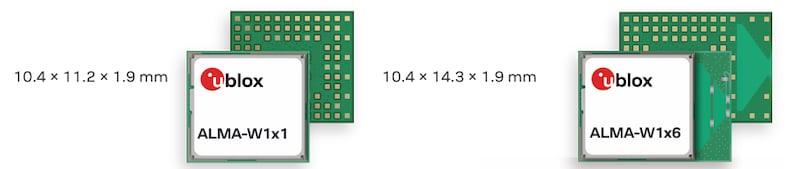
The ALMA-W1 series comes in two sizes: the smaller W1x1 supports an external antenna, and the larger W1x6 features an integrated PCB antenna. Image used courtesy of U-blox
Both wireless modules operate from 2.8 V to 5.5 V and can handle temperatures from -40°C to +85°C. As for software, developers can program the wireless MCU versions using Nordic’s nRF Connect SDK or use U-blox’s u-connectXpress software on the network processor models. The latter uses AT commands, which can save some development work if the device already has a main controller.
Making Wi-Fi Work on Battery Power
The ALMA-W1 targets industrial monitoring, medical devices, smart buildings, and other connected equipment where power consumption and board space matter. Initial samples are available to select customers, although the preliminary documentation still lists regulatory certifications as pending.
The low standby current makes the ALMA-W1 worth a closer look, especially for devices that only need to communicate periodically. Adding local AI processing is another useful option, but engineers will still need to measure power consumption under their actual workloads. An 8-µA standby figure is a good starting point, not a complete battery-life calculation.
All images used courtesy of U-blox.